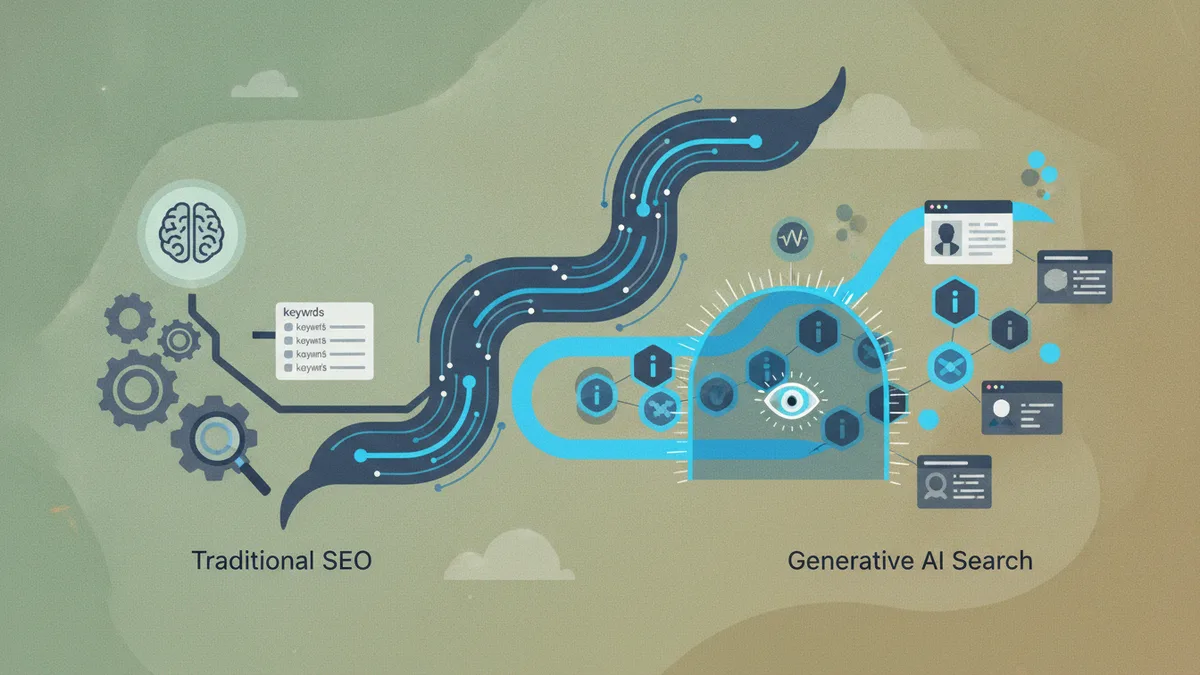
AI Visibility Checker: Your Guide to Being Found in Generative Search
Learn what an AI visibility checker is and how to use one to improve your business visibility in ChatGPT, Google AI Overview, and other generative search engines.
An AI visibility checker is a diagnostic tool that measures how easily your business, products, and content are discovered and cited by generative AI Search engines like ChatGPT, Google's AI Overview, and other large language model-powered platforms. Unlike traditional SEO visibility tools that track keyword rankings in standard search results, an AI visibility checker evaluates whether your brand appears in AI-generated answers, recommendations, and citations—a fundamentally different discovery mechanism that requires different measurement approaches and optimization strategies.
- AI visibility differs from traditional search visibility because generative engines cite sources rather than rank them, and citation patterns depend on topical authority and structured data rather than keyword density alone.
- An AI visibility checker reveals gaps between your content coverage and the topics your target audience asks AI systems about.
- Improving AI visibility requires a combination of content depth, topical clustering, and schema markup implementation.
- Measurement should focus on citation frequency and topic coverage rather than impression counts or click-through rates.
How AI Visibility Differs from Traditional Search Visibility
Traditional SEO Tool measure visibility by tracking where your website ranks for specific keywords in standard search results. An AI visibility checker operates on a different principle: it measures whether your content is cited as a source when an AI system generates an answer to a user query. This distinction matters because the mechanisms that drive visibility are not identical. A page that ranks first for a keyword in Google's standard results may not be cited by ChatGPT for the same query, and vice versa.
Generative AI systems use topical authority and content comprehensiveness as primary signals for citation selection. When a user asks ChatGPT about a topic, the system scans its training data for authoritative, well-organized content that demonstrates deep knowledge of that subject. It then cites sources that best answer the specific question. This process rewards brands that have built clusters of related content around a topic, not just single high-ranking pages. A traditional SEO Tool might show you ranking for 50 keywords; an AI visibility checker will show you whether your brand is cited as an authority across the topic area those keywords represent.
Another key difference lies in how visibility is measured. Traditional tools count impressions and track rank position. AI visibility checkers focus on citation presence and frequency—whether your content appears in AI-generated answers at all, and how often it is selected as a source across different query variations within your topic area.
What an AI Visibility Checker Actually Measures
A functional AI visibility checker tracks three core metrics: citation presence (whether your domain appears in AI-generated answers for queries in your industry), citation frequency (how often your content is cited across multiple query variations), and topical coverage gaps (which related topics your content addresses and which ones lack sufficient depth). These measurements reveal how generative AI systems perceive your brand's authority and completeness.
Citation presence is the most basic metric. It answers the question: does this AI system cite my content at all when answering questions in my industry? This is binary—either your domain appears or it does not. An AI visibility checker performs this check across a sample of relevant queries to determine your citation baseline. A brand selling project management software, for example, might discover that it is cited in AI answers about task management workflows but not about resource allocation or team collaboration features.
Citation frequency measures how consistently your content is selected as a source. If your domain appears in 15% of AI-generated answers about your core topic, that is a meaningful citation rate. If it appears in 3%, your visibility is low. An AI visibility checker aggregates this data across dozens or hundreds of related queries to establish a pattern. This metric is more useful than citation presence alone because it reveals whether you are a peripheral source or a primary authority.
Topical coverage gaps are the most actionable measurement. An AI visibility checker can identify which subtopics within your industry are well-covered by your content (and therefore likely to generate citations) and which are underrepresented. For a SaaS Company selling marketing automation software, this might reveal strong citation patterns for content about email segmentation but weak patterns for content about predictive analytics—a clear signal about where to invest in content development.
Why Traditional SEO Tool Miss AI Visibility
Standard SEO visibility tools were built to measure ranking position and keyword coverage in traditional search engines. They track metrics like search volume, keyword difficulty, and rank position because those are the signals that drive traffic in standard search. Generative AI Search operates on a different layer and uses different signals, so traditional tools cannot measure it accurately.
A keyword ranking tool will tell you that you rank #3 for a search term. But that tells you nothing about whether ChatGPT cites your content when answering the same question. The ranking position is irrelevant to generative search. What matters is whether your content is comprehensive, well-structured, and perceived as authoritative by the AI system's training process. A page that ranks #10 in standard search might be cited by ChatGPT because it provides the most direct answer to a specific question, while a #1-ranking page might not be cited at all if it does not address the question the AI system is answering.
Traditional tools also focus on individual page performance. They show you which pages rank for which keywords. AI visibility checkers focus on domain-level and topic-level authority. Generative AI systems evaluate your entire body of work on a topic, not just individual pages. This is why content clustering and topical authority matter more than single-page optimization.
How to Evaluate Your Current AI Visibility
Begin by manually testing your AI visibility across the platforms your audience uses most. Open ChatGPT, Google's AI Overview, or other generative search engines and ask questions that your target customers would ask. Note whether your brand or content appears in the AI-generated answer. Repeat this process across 20–30 relevant queries covering different aspects of your industry. This manual audit reveals your baseline citation presence and identifies patterns in which topics generate citations and which do not.
Document your findings in a simple spreadsheet: query, platform, whether you were cited, which competitor was cited instead (if any), and the specific content from your site that was cited (if it was). After 20–30 queries, patterns will emerge. You will likely discover that you are cited for some topics but not others, or cited by some platforms but not others. This is your starting point for improvement.
The second step is to assess your content structure and schema markup. Generative AI systems rely on clear, well-organized content and structured data to understand your topical authority. Review your website's information architecture: are your topics organized into clear clusters? Does each topic have a pillar page that links to related subtopic pages? Is your schema markup present and accurate? Many brands discover that their content is scattered across unrelated pages rather than organized into coherent topic clusters, which reduces AI visibility even if individual pages rank well in traditional search.
The third step is to identify content gaps. Based on your manual testing, which queries did not cite your content? Which competitor content appeared instead? These gaps represent opportunities. If a competitor is cited for a topic you do not address, you have a clear content development priority. If a query goes unanswered by any brand (including yours), that is a lower-priority gap.
Core Optimization Strategies That Improve AI Visibility
Improving AI visibility requires a different approach than traditional SEO optimization. Rather than optimizing individual pages for keyword ranking, you must build topical authority by creating comprehensive, interconnected content clusters and implementing structured data that helps AI systems understand your expertise.
Build Topical Authority Through Content Clustering
Topical authority is the foundation of AI visibility. Generative AI systems evaluate your entire body of content on a topic to determine whether you are a reliable source. A single comprehensive page is less valuable than a cluster of related pages that collectively demonstrate deep expertise. This means organizing your content strategy around topics rather than keywords.
For example, instead of writing individual blog posts about "email segmentation," "list management," and "automation workflows," organize them as subtopics within a broader "email marketing" topic cluster. Create a pillar page that covers email marketing at a high level, then create detailed subtopic pages that explore specific aspects. Link these pages together strategically so that AI systems can see the relationships between topics. This structure signals to generative AI that you have comprehensive coverage of the topic area, which increases the likelihood of citation.
Implement Schema Markup for Clarity
Schema markup is structured data that helps AI systems understand the content on your pages. While schema markup alone does not guarantee AI visibility, it significantly improves the chances that your content will be correctly understood and cited. The most relevant schema types for improving AI visibility are Organization, Article, FAQPage, and Product schema, depending on your industry.
Schema markup tells AI systems explicitly what your content is about, who created it, when it was published, and how it relates to other content. This reduces ambiguity and makes your content easier to cite. A page with proper schema markup is more likely to be selected as a source because the AI system can quickly verify that it is authoritative and relevant.
Develop Content That Answers Specific Questions
Generative AI systems are designed to answer questions, not to rank pages. Your content should be structured around the questions your audience asks, not around keywords you want to rank for. This shift in perspective is critical. Instead of writing a blog post titled "The Complete Guide to Email Marketing," write content that directly answers specific questions: "What is email segmentation and why does it matter?" "How do you set up automated email workflows?" "What are the best practices for list management?"
This question-focused approach aligns your content with how generative AI systems retrieve and cite sources. When a user asks ChatGPT a specific question, the system looks for content that directly answers that question. Content structured around specific questions is more likely to be cited than content that covers a topic broadly without addressing specific user questions.
Measuring Progress and Refining Your Strategy
After implementing visibility improvements, you need a method to measure progress. Repeat your manual testing quarterly using the same set of queries you tested initially. Track changes in citation presence and frequency. Are you cited more often? Are you cited for additional topics? Are you being selected instead of competitors?
You should also monitor your content performance in traditional search alongside AI visibility metrics. Improving AI visibility often improves traditional search visibility as well because the underlying mechanisms—topical authority, content quality, and structured data—benefit both discovery methods. However, the metrics are distinct, so track them separately.
As you gather data about which topics generate citations and which do not, use that information to refine your content strategy. Double down on topics where you are cited frequently. Investigate topics where you are not cited and determine whether the issue is insufficient content depth, poor content structure, missing schema markup, or lack of topical authority. Each diagnosis leads to a different solution.
One important note: improving AI visibility is a longer-term effort than traditional SEO. Generative AI systems are trained on data that can be months or years old, so new content you publish today may not appear in AI citations for weeks or months. This delay is normal and does not indicate failure. Maintain consistency in your content development and measurement practices over a 6–12 month period to see meaningful progress.
Next Steps for Your AI Visibility Strategy
Start with a manual audit of your current AI visibility using the approach described above. Document which queries cite your content and which do not. Identify your top 3–5 content gaps based on competitor citations and unanswered questions in your industry. Then prioritize content development around those gaps, organizing new content into topical clusters and implementing schema markup as you publish.
If you want to accelerate this process and gain deeper insights into your AI visibility patterns, learn how marketing teams win in generative search with a structured approach to visibility strategy. For specific guidance on securing recommendations from ChatGPT and other AI systems, explore the mechanics of how to get your business recommended by ChatGPT. Both resources provide actionable frameworks that complement the measurement and optimization strategies covered here.
Ready to Get Found by AI Search Engines?
Schema injection plus up to 10 autopilot SEO articles a month. One script tag. Set it once and let it run.