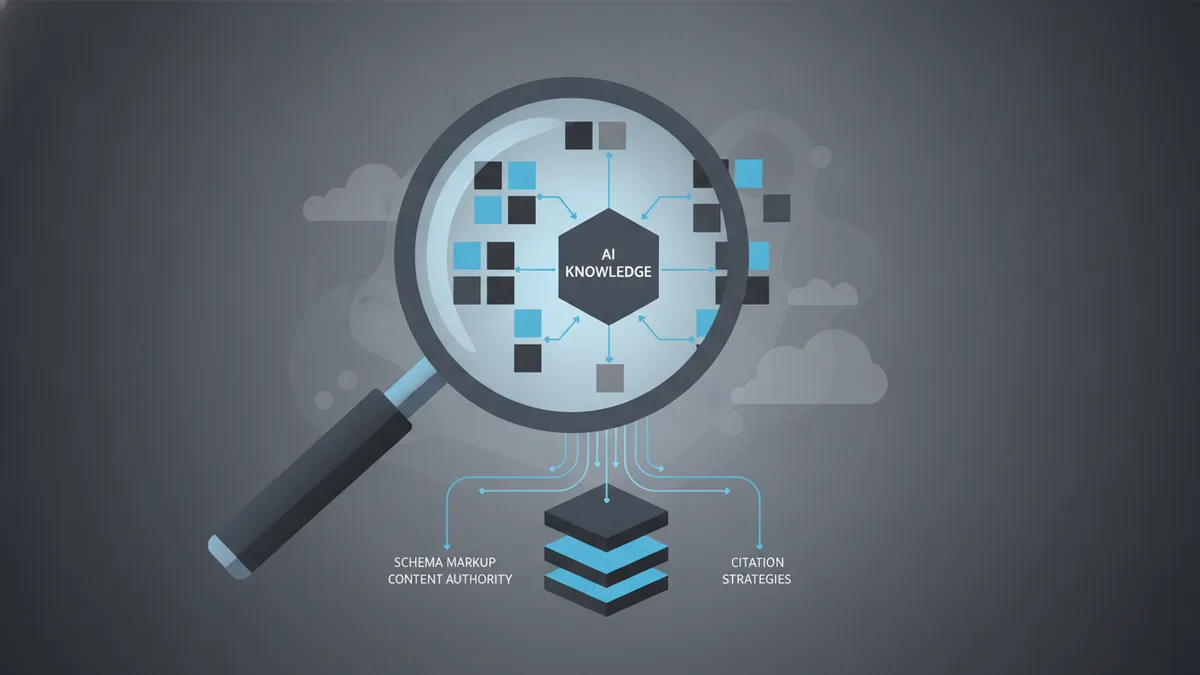
How to Get Your Business Recommended by ChatGPT: A Strategic Framework
Learn how to get your business recommended by ChatGPT through schema markup, content authority, and citation strategies that work across generative AI platforms.
Getting your business recommended by ChatGPT requires a fundamentally different approach than traditional search engine optimization. Rather than competing for keyword rankings on a results page, you're now competing to be cited as a trusted source when an AI model generates an answer to a user's question. This shift demands that you build topical authority, implement structured data correctly, and create content that AI systems recognize as credible and comprehensive. The core mechanism is straightforward: AI models pull from their training data and real-time sources to construct answers; if your content is well-organized, properly marked up, and demonstrates clear expertise, it becomes a natural candidate for citation.
ChatGPT Citations vs. Traditional Search Rankings: Where They Diverge
ChatGPT and similar large language models (LLMs) do not operate on the same ranking algorithm as Google or Bing. Traditional search engines index billions of pages and rank them by relevance, authority, and user engagement signals. ChatGPT, by contrast, was trained on a snapshot of internet data up to a specific date, and its responses are generated by predicting the most probable next token based on patterns learned during training. When ChatGPT cites a source, it is drawing from its training knowledge or, in some cases, from real-time retrieval systems that fetch current information. Understanding this distinction is critical because it changes how you should structure your content and what signals matter most.
Traditional SEO optimizes for crawlability, keyword matching, and backlink authority. Generative engine optimization focuses on clarity, topical depth, structured data accuracy, and the likelihood that your content will be selected as a representative answer to a specific query. A page that ranks well on Google may not be cited by ChatGPT if it lacks schema markup, buries key information in narrative prose, or fails to establish clear topical authority. Conversely, a well-structured resource page with proper JSON-LD markup and comprehensive coverage of a topic may be cited by ChatGPT even if it does not rank in Google's top ten results. The two approaches are complementary but not identical.
| Criterion | Traditional SEO (Google, Bing) | ChatGPT Citations |
|---|---|---|
| Primary Signal | Backlinks, keyword relevance, user engagement (CTR, dwell time) | Structured data accuracy, topical authority, content clarity |
| Content Format | Narrative blog posts, landing pages, product pages | Comprehensive guides, FAQs, schema-marked definitions, resource lists |
| Speed of Update | Weeks to months after indexing | Depends on LLM training cycle or real-time retrieval integration |
| Citation Visibility | URL appears in search results; user clicks through | URL or brand name cited in conversational response; user may or may not click |
| Ranking Factors | Domain authority, page speed, mobile-friendliness | Schema completeness, topical clustering, answer specificity |
Building Topical Authority: The Foundation for AI Recommendations
Topical authority is the single most important factor in earning ChatGPT citations. Unlike traditional SEO, where you can rank for a keyword with a single well-optimized page, ChatGPT evaluates your entire domain's coverage of a subject area. If you publish one article on "B2B SaaS pricing models" but have no other related content on SaaS, licensing, or enterprise software, ChatGPT is less likely to cite you as an authority on the topic. However, if you have ten to twenty interconnected articles covering SaaS pricing, contract negotiation, vendor selection, implementation timelines, and cost comparison frameworks, ChatGPT recognizes your domain as a topical hub and is far more likely to cite you when answering related questions.
Building topical authority requires a systematic content strategy. Start by mapping the full scope of your subject area—not just the keywords you want to rank for, but every related question, subtopic, and edge case your audience might ask. Then create content that addresses each of these areas with depth and precision. The goal is not to publish as many articles as possible, but to publish enough interconnected, well-structured content that search systems and AI models recognize you as a comprehensive resource. For most B2B SaaS companies, this means publishing between 8 and 15 articles per month over several months to establish clear topical authority. Each article should link to related articles on your site, creating an internal network that reinforces your expertise.
Schema Markup: Making Your Content Machine-Readable
Schema markup is the language that tells AI systems what your content is about and how to interpret it. Without schema, ChatGPT and other generative engines must infer meaning from your text alone, which introduces ambiguity and reduces the likelihood of citation. With proper schema markup, you explicitly declare the structure and meaning of your content, making it far easier for AI systems to extract accurate information and cite you as a source.
Which Schema Types Matter Most for ChatGPT Citations
Not all schema types are equally valuable for AI recommendations. The most important schema types for generative engine optimization are FAQ, Article, BreadcrumbList, and Organization. FAQ schema is particularly powerful because ChatGPT frequently pulls from FAQ content when answering user questions. When you mark up your FAQs with proper schema, you make it trivial for the AI to extract question-answer pairs and cite your page as the source. Article schema signals that your page is a published, authoritative piece of content with a clear author, publication date, and topic. BreadcrumbList schema helps establish how your content fits into a larger topical hierarchy, which reinforces topical authority. Organization schema ensures that ChatGPT correctly attributes information to your company, not a competitor or generic entity.
For ecommerce businesses and product-focused companies, Product schema and Review schema are also critical. These schema types allow ChatGPT to understand product features, pricing, availability, and customer sentiment, which directly influences whether your products are recommended in response to shopping queries. Schema markup and content strategy for ecommerce requires particular attention to accuracy and completeness, since AI models rely heavily on structured data to compare products and make recommendations.
Implementation Best Practices
Schema markup must be accurate and comprehensive to be effective. Incomplete schema—for example, an FAQ entry with a question but no answer—signals poor data quality and may reduce your credibility with AI systems. Every schema field should be populated with real, specific information from your content. Dates should be accurate; author names should be real; URLs should be canonical and permanent. Avoid keyword stuffing within schema markup; AI systems are sophisticated enough to detect and penalize artificially inflated or misleading schema. The schema should be a true reflection of your content's structure and meaning.
Content Depth vs. Brevity: What ChatGPT Actually Prefers
A common misconception is that ChatGPT prefers short, snappy content. In reality, ChatGPT citations are heavily weighted toward comprehensive, in-depth resources that thoroughly address a topic. When ChatGPT generates an answer, it draws from multiple sources and synthesizes information; it is more likely to cite a source that provides complete, nuanced coverage than one that offers a superficial overview. This does not mean every article needs to be 5,000 words, but it does mean that your content should be thorough enough to stand alone as a reference.
The optimal content length for ChatGPT citations is typically 1,500 to 3,500 words per article, depending on topic complexity. Within that range, prioritize depth over length. A 2,000-word article that covers a topic comprehensively, with clear subheadings, examples, and actionable advice, is far more likely to be cited than a 3,500-word article that repeats the same points or includes filler. Structure your content with clear hierarchy using H2 and H3 headings; this makes it easier for AI systems to parse and extract specific information. Use lists, tables, and examples to break up text and improve readability—these formatting elements also make it easier for AI to extract structured information.
Citation Signals: How ChatGPT Decides Which Sources to Recommend
ChatGPT does not have access to traditional SEO metrics like backlinks or domain authority in the way that Google does. Instead, it evaluates sources based on signals embedded in the content itself and patterns learned during training. Several factors influence whether your content is cited: topical relevance (does your content directly address the user's question?), specificity (does your content provide concrete examples, data, or actionable advice?), recency (is your content current, or does it reference outdated information?), and clarity (is your content well-written and easy to understand?).
Brand recognition also plays a role. If your company is well-known in your industry, ChatGPT is more likely to cite you, all else being equal. However, brand recognition alone is not sufficient; your content must still meet the quality and relevance standards outlined above. For smaller or newer companies, this means you must compensate for lower brand recognition by producing exceptionally thorough, well-structured content with comprehensive schema markup. Strategic approaches to AI Search visibility emphasize the importance of building a recognizable topical footprint through consistent, high-quality content production over time.
Execution Strategy: From Planning to Consistent Publication
Getting your business recommended by ChatGPT is not a one-time project; it requires sustained, systematic effort. The most effective approach is to establish a content production cadence that allows you to build topical authority over months, not weeks. For most B2B companies, this means committing to publishing between 8 and 12 new, high-quality articles per month, each addressing a distinct subtopic within your area of expertise. This level of output is challenging to maintain manually, but it is achievable with the right tools and processes.
Start by conducting a comprehensive content audit. Identify every topic, question, and subtopic related to your core business that your audience might search for or ask ChatGPT about. Organize these topics into a content map that shows how they relate to each other and to your core value proposition. Then prioritize topics based on search volume, business relevance, and competitive opportunity. Next, establish a publication schedule that allows you to produce content consistently without overwhelming your team. If your team can produce four articles per month internally, consider supplementing with external writers or automated content systems to reach eight to twelve articles per month. Each article should follow a consistent template that includes proper schema markup, clear headings, examples, and internal links to related content.
Consistency matters more than perfection. Publishing one exceptional article per month and then going silent for two months is far less effective than publishing eight solid articles per month consistently. ChatGPT and other AI systems reward domains that demonstrate ongoing expertise and topical depth. A domain that publishes regularly on a topic signals that it is an active, invested resource; a domain that publishes sporadically signals that expertise is secondary to other priorities.
Next Steps: Building Your Generative Engine Visibility Strategy
Getting your business recommended by ChatGPT is achievable, but it requires a clear strategy and sustained execution. Begin by mapping your topical landscape and committing to a consistent content publication schedule. Ensure that every piece of content is properly marked up with relevant schema and structured for clarity. Monitor your progress by tracking which of your pages are cited in ChatGPT responses and which topics are generating the most visibility.
If your team lacks the capacity to produce high-quality content at scale, consider tools and platforms that can help automate parts of the process while maintaining quality standards. The goal is to establish topical authority systematically, not to cut corners or publish low-quality content in volume. With the right approach and commitment, your business can become a trusted source that ChatGPT and other generative AI systems recommend to their users.
Ready to Get Found by AI Search Engines?
Schema injection plus up to 10 autopilot SEO articles a month. One script tag. Set it once and let it run.