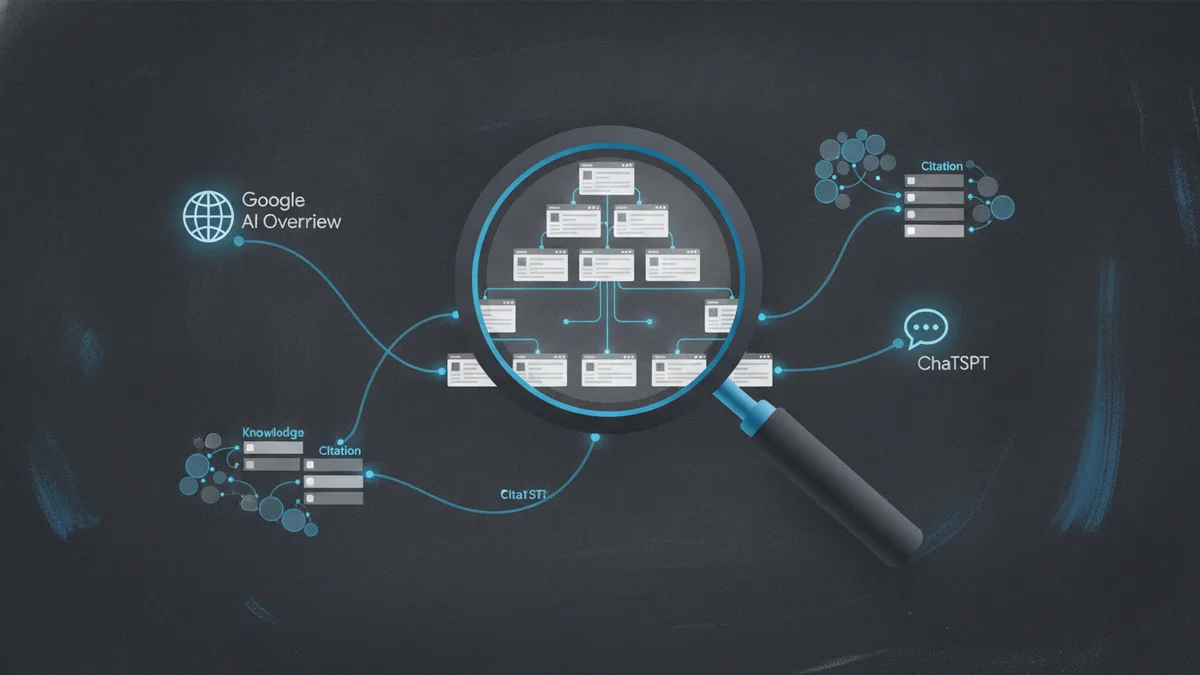
AI SEO for Ecommerce: Schema, Content, and Visibility Strategy
Master AI SEO for ecommerce with schema markup and topical authority strategies that secure citations in generative search results.
AI-Powered search engines like ChatGPT and Google's AI Overview are reshaping how customers discover products. To win visibility in these systems, ecommerce brands must move beyond traditional keyword optimization and adopt a three-part strategy: structured data implementation, topical authority building, and citation positioning. This guide walks you through each component so you can make informed decisions about where to invest your marketing resources.
Why Ecommerce Brands Need a Separate AI Search Strategy
Generative search engines operate on fundamentally different principles than keyword-based indexing. When a customer asks ChatGPT or Google's AI Overview a question about a product category, the AI synthesizes information from multiple sources and presents a conversational answer—often with citations. Traditional SEO optimizes for ranking position on a results page. AI Search optimization focuses on being selected as a trusted source when the AI constructs its response.
Ecommerce sites face a specific challenge: product pages and category pages are often thin on explanatory content. A product listing page might contain a title, price, and bullet points, but lacks the depth that helps an LLM understand your brand's expertise. Generative search systems reward breadth of topical coverage and authoritative explanation. This is why many ecommerce brands discover their visibility in AI Overview or ChatGPT is lower than their organic search rankings suggest it should be.
The strategic shift requires treating your ecommerce site as a knowledge resource, not just a transaction platform. That does not mean abandoning product pages—it means building supporting content that demonstrates authority and provides the context AI systems use to rank sources.
How JSON-LD Schema Markup Improves AI Search Visibility
JSON-LD schema markup is a standardized format for embedding structured data into your HTML. For ecommerce, the most relevant schemas are Product, Organization, BreadcrumbList, and FAQPage. When you implement schema markup correctly, you provide AI systems with machine-readable context about your products, business, and content relationships—information that helps the AI understand and cite your site with confidence.
Schema markup does not guarantee AI Overview inclusion or ChatGPT citations. However, it removes friction from the AI's ability to extract accurate information about your offerings. An AI system can infer details from unstructured text, but it works faster and with higher confidence when data is explicitly labeled. For ecommerce, this means your product attributes, pricing, availability, and review data become immediately usable by generative systems.
Core Schema Types for Ecommerce Brands
Product schema should include name, description, image, price, currency, availability, and aggregate rating if you have reviews. This schema tells AI systems what you sell and helps them match your products to customer queries. Organization schema establishes your brand identity, location, contact information, and social profiles—critical for building trust signals that influence citation selection. BreadcrumbList schema shows the hierarchical structure of your site, helping AI systems understand how product categories relate to one another. FAQPage schema marks up frequently asked questions and answers, which is particularly valuable because generative search systems often pull from FAQ content when answering customer questions.
The implementation method matters. Manually adding schema to every product page is labor-intensive and prone to errors. Automated schema injection—where a script tag applies schema rules across your entire site—reduces maintenance burden and ensures consistency. This approach is especially valuable for ecommerce sites with hundreds or thousands of products.
Schema Markup and Citation Positioning
When Google's AI Overview or ChatGPT cites your site, it typically displays your brand name, a snippet of text, and a link. Schema markup does not control the citation text, but it does help the AI understand which parts of your content are most relevant to the user's query. Product schema with rich descriptions makes it easier for the AI to extract a meaningful snippet. Organization schema with a clear mission statement gives the AI context for positioning your brand as an authority.
Think of schema markup as a translation layer between your human-readable content and the AI's interpretation engine. The more accurate and complete your schema, the more reliably the AI can represent your brand in its response.
Building Topical Authority to Earn AI Search Citations
Topical authority is the practice of creating comprehensive content across a topic cluster so thoroughly that search engines and AI systems recognize your site as a trusted expert. For ecommerce, this means moving beyond product descriptions to build a content ecosystem that explores the problems your products solve, the decisions customers face, and the knowledge they need to make informed purchases.
An ecommerce brand selling fitness equipment, for example, might have product pages for dumbbells, resistance bands, and kettlebells. Topical authority means also publishing articles about strength training principles, workout programming, recovery techniques, and equipment selection criteria. When a customer asks an AI system, "How do I choose between dumbbells and kettlebells?", your site becomes a candidate for citation because you have demonstrated comprehensive knowledge across the fitness equipment category.
This content serves a dual purpose: it attracts organic search traffic from informational queries (which often have high commercial intent), and it signals to AI systems that your brand understands the customer's full decision journey, not just the transaction moment.
Structuring Content for AI Discovery
AI systems evaluate topical authority by analyzing the breadth and depth of your content coverage, the consistency of your terminology, and the internal linking patterns that show how topics relate. A scattered collection of blog posts does not create topical authority; a structured content plan does.
Start by mapping the core topics your customers care about. For an ecommerce brand, this typically includes product categories, use cases, comparison guides, maintenance or care instructions, and industry trends. Create a content outline that shows how these topics connect. Then prioritize publishing content that fills the gaps in your current site. If you have 50 product pages but zero comparison guides or educational content, comparison guides should be your first priority because they directly address the decision-making queries that AI systems receive.
Internal linking is the mechanism that communicates topical relationships to AI systems. When you link from a comparison guide to relevant product pages, and from product pages back to category-level educational content, you create a content network that demonstrates expertise. AI systems crawl these links to understand the scope and structure of your knowledge.
Consistency and Citation Frequency
Topical authority is not built overnight. Brands that publish one article per month will take years to achieve the content density that AI systems recognize as authoritative. Conversely, brands that commit to consistent, structured content production—such as publishing multiple SEO-optimized articles per month focused on a specific topic cluster—can build recognizable authority within months.
The payoff is measurable in citation frequency. As your topical authority grows, AI systems begin citing your site more often in response to queries in your domain. This creates a compounding effect: more citations drive more referral traffic, which signals to AI systems that your content is valuable, which increases citation frequency further.
Choosing Between Owned Content and Automated Publishing
Building topical authority requires consistent content production, but most ecommerce marketing teams operate with limited editorial resources. This creates a decision point: should you hire writers, use freelancers, or explore automated content solutions?
Owned content—articles written by your in-house team or contracted writers—offers maximum control over brand voice, accuracy, and strategic alignment. You can ensure every article reflects your unique perspective and brand values. The tradeoff is cost and time. Hiring a full-time content writer or managing a freelance network requires budget and operational overhead.
Automated publishing services use AI and templates to generate SEO-optimized articles at scale. The advantage is speed and volume: you can publish 10 or more articles per month without expanding your team. The tradeoff is customization and brand voice. Automated content is typically more generic and requires editorial review to ensure accuracy and alignment with your brand positioning.
A hybrid approach is common: use automated publishing to build content volume and topical coverage quickly, then layer in owned content for high-value topics where brand voice and unique insight matter most. This strategy lets you achieve the citation frequency benefits of topical authority without the cost of 100% custom content production.
Evaluating Content Quality for AI Systems
Not all content contributes equally to AI Search visibility. AI systems evaluate content quality based on several factors: topical relevance (does this article address a query the AI receives?), expertise signals (does the author demonstrate knowledge?), comprehensiveness (does the article cover the topic thoroughly?), and freshness (is the information current?).
When evaluating whether to publish or automate content, ask: Does this article answer a real customer question? Does it provide information that helps customers make decisions? Is it accurate and up-to-date? If the answer to all three is yes, the content has value for AI Search visibility—whether it was written by a human or generated by AI.
The risk of automated content is not that it is AI-generated; it is that it is generic, inaccurate, or misaligned with your brand. Before publishing any content—owned or automated—review it for factual accuracy, specificity to your business, and relevance to your customers' actual questions.
Integrating AI SEO with Traditional Search and Paid Strategy
AI Search optimization is not a replacement for traditional SEO, paid search, or content marketing. Instead, it is a complementary layer that helps you reach customers through a new channel. Your strategy should integrate all three.
Traditional organic search remains the highest-volume channel for most ecommerce brands. Customers searching for specific products or product categories still use Google Search, and ranking well there drives consistent traffic. AI Search optimization does not cannibalize this traffic; it expands your reach by making you visible in a new type of search interface.
Paid search (Google Ads, shopping ads) remains essential for capturing high-intent customers at the moment of purchase. AI Search optimization can drive awareness and consideration earlier in the customer journey, but it does not replace the immediate conversion opportunity of paid search.
The three channels work together: paid search captures high-intent traffic today, traditional SEO builds long-term organic visibility, and AI Search optimization establishes your brand as a trusted authority that customers encounter when they are asking exploratory questions. A customer might discover your brand through an AI Overview citation, then search for your products on Google, then click your paid ad to complete a purchase. Each channel contributed to the outcome.
Measuring AI Search Visibility and Impact
Unlike traditional SEO, where you can track rankings and organic traffic directly, AI Search visibility is harder to measure. Google Search Console does not report AI Overview clicks separately, and ChatGPT does not provide citation analytics. This creates uncertainty about ROI, but it does not mean measurement is impossible.
Start by tracking brand mentions and citations in AI systems manually. Search for your target keywords in Google's AI Overview and ChatGPT, and note whether your site is cited. Do this monthly to identify trends. If your citation frequency is increasing, your topical authority strategy is working. If it is flat or declining, you may need to adjust your content focus or expand your topical coverage.
Indirect measurement is also valuable. Monitor organic search traffic from informational queries—articles, comparison guides, and educational content. If this traffic is growing, it signals that your topical authority content is resonating with search engines and users. This same content is typically what AI systems cite, so growth in informational traffic often correlates with improved AI Search visibility.
Finally, track referral traffic from AI systems if possible. Some AI platforms may send referral traffic with identifiable source information. While this is not guaranteed, it provides a direct signal of AI Search impact on your business.
Next Steps: Building Your AI SEO Foundation
Implementing AI SEO for ecommerce requires three immediate actions. First, audit your current site structure and identify gaps in topical coverage. Map the topics your customers care about, then assess which topics are well-covered and which are missing. Second, implement structured data markup across your product pages and key content. If manual implementation is impractical, explore automated schema injection solutions. Third, commit to a content production schedule that builds topical authority over time—whether through owned content, automated publishing, or a hybrid approach.
These steps lay the foundation for AI Search visibility. As you execute, you will build the topical authority and structured data signals that help AI systems recognize your brand as a trusted source. For teams looking to accelerate this process, Google AI Overview optimization frameworks provide step-by-step guidance tailored to ecommerce. Additionally, learning how to implement generative engine optimization at scale can help marketing teams and agencies move beyond manual processes and build sustainable AI Search strategies.
Ready to Get Found by AI Search Engines?
Schema injection plus up to 10 autopilot SEO articles a month. One script tag. Set it once and let it run.