Google AI Overview Optimization: A Strategic Framework for Marketing Teams
Learn how to optimize for Google AI Overview and generative search engines. A step-by-step guide for marketing managers and agencies building AI visibility.
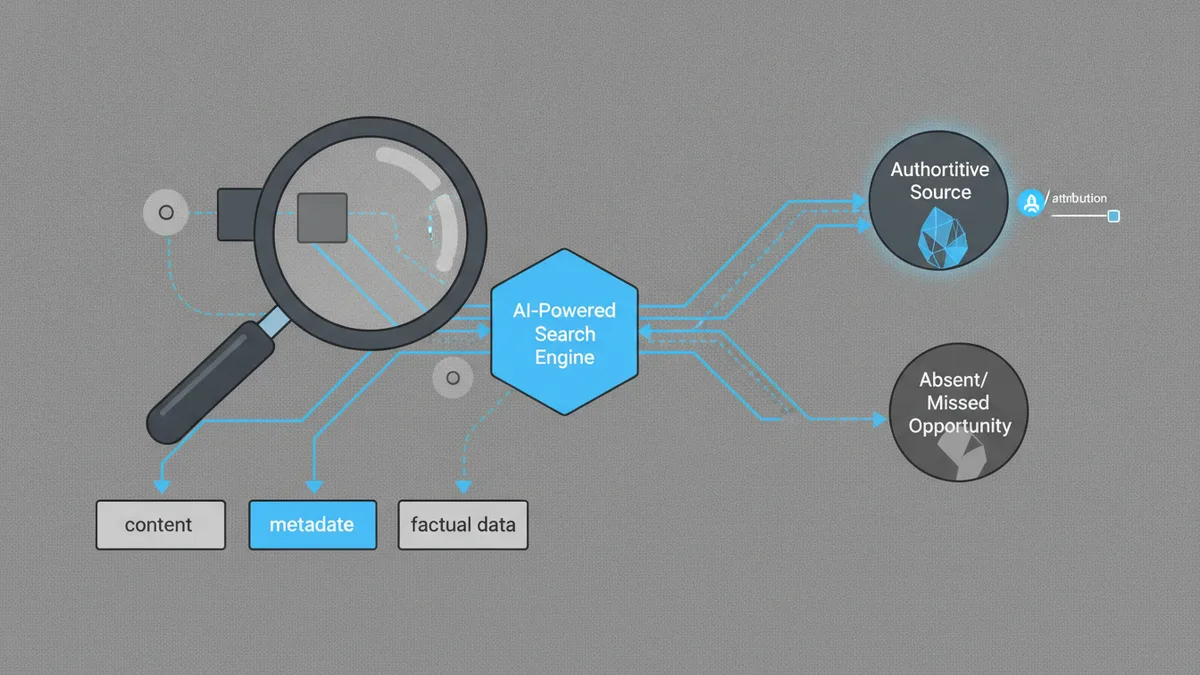
Google AI Overview optimization is the practice of structuring your content, metadata, and factual data so that AI-Powered search engines like Google's AI Overview and ChatGPT can discover, understand, and cite your brand as an authoritative source. Unlike traditional SEO, which targets keyword rankings and click-through rates, AI Overview optimization focuses on making your information machine-readable and contextually relevant to the reasoning processes that large language models use when generating answers. The core mechanism is semantic markup—primarily JSON-LD schema—combined with topical authority signals that demonstrate expertise across related topics.
- AI Overview optimization requires structured data markup and topical content clusters, not just individual blog posts
- Schema markup alone is insufficient; you need supporting content that establishes topical authority
- AI Search visibility is distinct from traditional search rankings and requires a separate measurement approach
- Automation tools can accelerate schema implementation and content production at scale
What Is Google AI Overview and Why Does It Matter?
Google AI Overview is a feature that appears at the top of Google Search results, displaying an AI-generated summary of information pulled from multiple web sources. Rather than showing ten blue links, the AI Overview synthesizes facts, definitions, and perspectives into a single answer block. For brands, this represents both an opportunity and a visibility challenge: your content can be cited as a source within that summary, or it can be entirely absent. When Google's AI system identifies your brand as a credible source on a topic, it may include your URL and a brief attribution. When it doesn't, your traffic from that search may drop significantly, even if your page ranks well in traditional organic results.
The shift matters because AI Overviews are now shown for millions of queries across search, shopping, and knowledge-based topics. Marketing teams that optimize for AI Overview visibility gain a second channel for brand exposure—one that sits above traditional organic results and often captures user attention before they click through to any individual website.
How AI Search Engines Decide Which Sources to Cite
AI-Powered search engines and chatbots use a multi-stage process to select sources for citations. First, they retrieve candidate documents from the web using semantic search—matching the meaning of a query to the meaning of content, not just keyword overlap. Second, they assess credibility signals, including domain authority, topical relevance, content freshness, and structured data markup. Third, they extract or synthesize information from the highest-scoring sources and generate a response. Finally, they attribute that information back to the original URLs. The entire process depends on machine-readable signals that your content provides.
Schema markup—particularly JSON-LD—is a primary credibility signal in this workflow. When you mark up your content with schema (for example, labeling an article with author, publication date, and topic tags), you reduce ambiguity for AI systems. Instead of inferring that a page is about "digital marketing," the system reads explicit markup stating the article covers "content strategy," "SEO," and "paid search." This precision increases the likelihood that the AI will match your content to relevant queries and cite it as a trusted source.
Topical authority reinforces this signal. If you have published ten articles on different aspects of e-commerce SEO, each marked with schema and internally linked, an AI system recognizes your site as an authority cluster on that topic. A single article on the same subject, without supporting content, receives lower weight.
The Role of Structured Data in AI Visibility
Structured data markup—most commonly JSON-LD—tells search engines and AI systems what your content is about, who created it, when it was published, and how it relates to other content. Without markup, an AI system must infer this information from HTML alone, which is slower and more error-prone. With markup, the system has explicit, machine-readable facts. For AI Overview optimization, schema serves three critical functions: disambiguation, credibility attribution, and topical linking.
Disambiguation and Content Classification
Schema markup removes ambiguity about what a page covers. An article titled "How to Build a Sales Funnel" could be about marketing strategy, software implementation, or psychology. Schema markup specifies the topic, the article type, the intended audience, and related concepts. This precision allows AI systems to match your content to the right queries with confidence.
Credibility and Authority Signals
Schema markup includes author information, publication dates, review ratings, and organizational details. When you mark up an article with the author's name, credentials, and publication date, you provide AI systems with verifiable credibility signals. AI systems weight recent content from recognized experts more heavily than undated content from unknown sources.
Topical Linking and Authority Clusters
Schema markup can include references to related articles, topics, and concepts. When you mark up multiple articles with interconnected schema that shows they all address different aspects of a single topic area, you signal topical authority. AI systems recognize this pattern and treat your site as a comprehensive resource on that subject.
For a detailed explanation of how to implement schema markup effectively, see JSON-LD schema markup and its role in AI Search visibility.
Building Topical Authority for AI Search Visibility
Topical authority is the foundation of AI Overview optimization. Rather than publishing isolated articles on random topics, you build a cluster of related content that collectively demonstrates deep expertise in a specific domain. AI systems recognize these clusters and prioritize them when answering questions in that domain. A brand with 12 interconnected articles on "content marketing strategy," "SEO copywriting," and "audience research" will rank higher in AI Overviews for queries in that space than a competitor with one high-quality article on each topic.
Building topical authority requires three elements: breadth, depth, and internal linking. Breadth means covering multiple subtopics within your domain—not just "SEO," but "technical SEO," "on-page SEO," "link building," and "content optimization." Depth means each subtopic receives thorough treatment, not a 500-word overview. Internal linking means connecting related articles so that AI systems can map the relationships between topics.
The process typically takes three to six months to show measurable results in AI Search visibility. During this period, you publish new content consistently, optimize existing content with schema markup, and build internal link structures that reinforce topical relationships. Automation can accelerate this timeline by handling schema injection and content production at scale, allowing marketing teams to focus on strategy rather than manual implementation.
Common Misconceptions About AI Overview Optimization
Several myths persist about how AI Overview optimization works, and clarifying them helps teams avoid wasted effort and misaligned expectations.
Misconception: Schema Markup Alone Guarantees AI Citations
Schema markup is necessary but not sufficient. You can mark up a mediocre article perfectly, and it still may not be cited in AI Overviews if the content lacks depth, the site lacks domain authority, or the topic is crowded with higher-authority competitors. Schema markup increases the probability of citation by removing ambiguity and signaling credibility, but it does not guarantee inclusion. The underlying content quality and topical authority are equally important.
Misconception: AI Overview Optimization Replaces Traditional SEO
AI Overview optimization and traditional SEO are complementary, not interchangeable. Traditional SEO focuses on keyword rankings and click-through rates from organic search results. AI Overview optimization focuses on being cited as a source within AI-generated summaries. Both matter. A page that ranks well in traditional search but lacks schema markup may not be cited in AI Overviews. A page with perfect schema markup but poor traditional rankings may never be discovered by AI systems in the first place. Teams should pursue both strategies in parallel.
Misconception: You Need Hundreds of Articles to Build Topical Authority
Topical authority depends on quality and interconnection, not volume. A cluster of 8–12 well-researched, internally linked articles on a specific topic can establish authority faster than 50 scattered articles on unrelated subjects. The key is strategic focus: choose a domain where your brand has genuine expertise, then build comprehensive coverage of that domain methodically.
Misconception: AI Overview Optimization Is a One-Time Task
AI systems continuously re-evaluate sources and update their citation patterns. Maintaining AI visibility requires ongoing content updates, schema maintenance, and competitive monitoring. As competitors publish new content and AI models improve, your relative position can shift. Treating AI Overview optimization as a maintenance process—not a project with a finish line—yields better long-term results.
Measuring AI Overview Visibility and Impact
Unlike traditional SEO, where ranking position and click-through rate are straightforward metrics, AI Overview visibility is harder to measure directly. Google does not provide a built-in report showing how often your site is cited in AI Overviews, and manual checking of thousands of queries is impractical. However, several proxy metrics can help you assess progress and identify opportunities.
Traffic attribution is the most direct signal. If traffic from a specific query or topic cluster increases after you optimize for AI Overview visibility, and you can rule out changes in traditional rankings, the increase likely comes from AI Overview citations. Use Google Analytics to segment traffic by topic and track changes over time. Watch for traffic spikes from queries you didn't previously rank for—these often indicate new AI Overview citations.
Topical authority metrics provide a secondary signal. Count the number of pages you have on a topic, measure their internal link density, and assess their average ranking position in traditional search. As these metrics improve, your AI visibility typically improves in parallel. Tools that track topical clusters and internal linking patterns can automate this measurement.
Competitive monitoring is also valuable. Identify competitors in your space, check which queries show AI Overviews with their citations, and test whether your content appears in those same Overviews. If you see gaps—queries where competitors are cited but you are not—you have identified optimization opportunities.
Practical Steps to Implement Google AI Overview Optimization
Implementation of Google AI Overview optimization follows a structured sequence. Begin by auditing your existing content and identifying a topic domain where your brand has depth and credibility. This domain should be narrow enough to cover comprehensively (8–12 articles) but broad enough to attract meaningful search volume. Examples include "B2B SaaS sales strategy," "sustainable packaging solutions," or "remote team management."
Next, audit your existing content in this domain. Which articles exist? Which topics are missing? Where are internal linking gaps? This audit reveals your starting point and guides your content roadmap. Prioritize filling gaps in coverage and strengthening internal link structures.
Then, implement schema markup across your topical cluster. Begin with Article schema (marking publication date, author, and topic) and expand to more specialized schema types as appropriate (e.g., HowTo schema for process-oriented content, FAQPage schema for Q&A content). Schema implementation can be done manually or automated; automation scales faster across large content libraries.
Simultaneously, create a content production plan for new articles that fill gaps in your topical coverage. Aim for one to three new articles per month, each addressing a distinct subtopic within your domain. Ensure each new article links to related existing articles and vice versa, building a web of interconnected content.
For a deeper exploration of implementation strategies, particularly for marketing agencies managing multiple client accounts, see generative engine optimization strategy and execution for agencies.
Finally, measure progress using the proxy metrics described above. Track traffic changes, monitor topical authority indicators, and periodically check whether your content appears in AI Overviews for target queries. Adjust your strategy based on results—double down on topics where you are gaining visibility, and investigate topics where competitors are outpacing you.
Next Steps: Building Your AI Overview Optimization Program
Google AI Overview optimization is not a quick fix or a single tactic. It is a strategic program that requires sustained effort in content production, technical implementation, and measurement. Teams that approach it methodically—defining a topical domain, building comprehensive coverage, implementing schema markup, and measuring results—see consistent improvements in AI Search visibility over three to six months.
If your team is managing multiple content assets or publishing at scale, automation tools can significantly accelerate the process. Automated schema injection eliminates manual markup work, and autopilot content services can produce a steady stream of topically relevant articles without straining your internal team. The combination of strategic focus and operational efficiency is what separates successful AI Overview optimization programs from scattered efforts that yield minimal results.
Start with a single topical domain where your brand has genuine expertise. Build a content cluster of 8–12 interconnected articles. Implement schema markup across all assets. Measure traffic and visibility changes over the next quarter. Use those results to refine your approach and expand to adjacent topic domains. This disciplined, iterative approach builds sustainable AI Search visibility and positions your brand as an authoritative source in your industry.
Ready to Get Found by AI Search Engines?
Schema injection plus up to 10 autopilot SEO articles a month. One script tag. Set it once and let it run.