AI Visibility Checker: Measuring Your Presence in Generative Search
Learn how an AI visibility checker measures your brand's presence in ChatGPT and Google AI Overview, and what metrics matter most for marketing leaders.
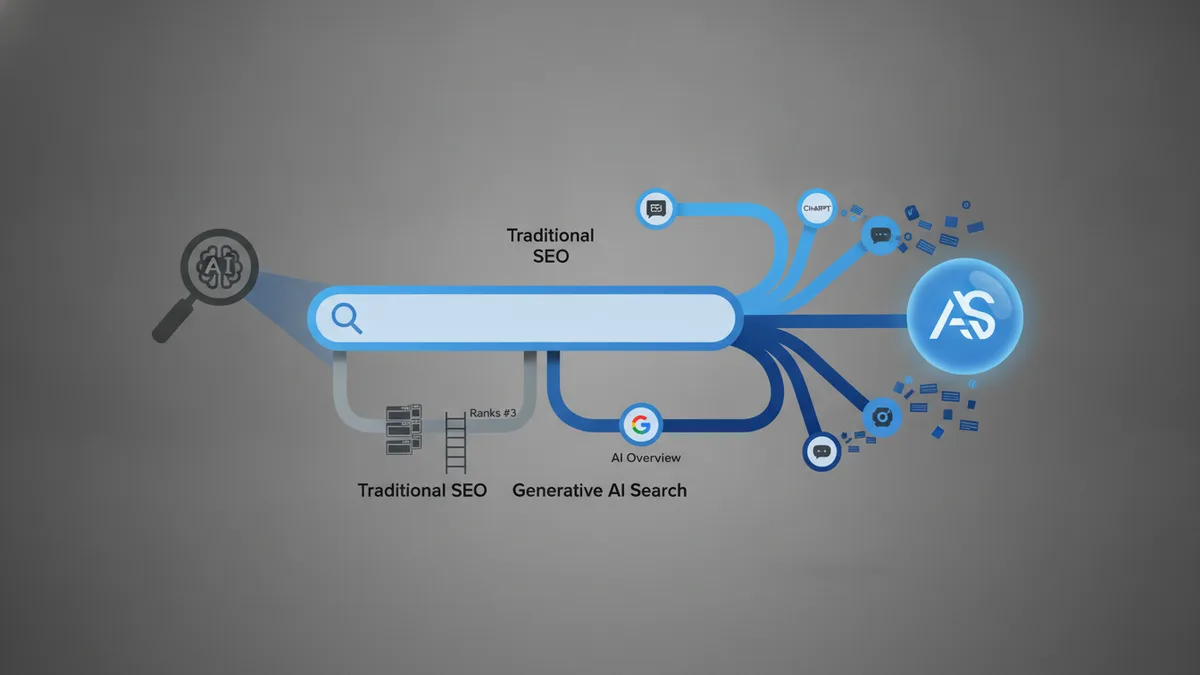
An AI visibility checker measures whether your business appears in generative AI Search results—specifically in tools like ChatGPT and Google's AI Overview. Unlike traditional SEO rank tracking, which counts keyword positions on search engine results pages, an AI visibility checker identifies whether your content is cited, recommended, or referenced when users ask questions that relate to your business, products, or industry. This distinction matters because generative search operates on a different citation model than keyword-based ranking. Google's AI Overview appears at the top of search results for roughly 40–50% of queries, and ChatGPT has over 200 million weekly active users, making visibility in these systems a strategic priority for marketing teams.
Why Traditional Rank Tracking Misses Generative Search Visibility
Traditional SEO Tool track keyword rankings—the position of your domain on a search engine results page for a specific term. Generative AI Search engines do not rank pages; they synthesize information from multiple sources and cite them in conversational answers. A keyword rank tracker will show you that your homepage ranks #3 for "enterprise CRM software," but it will not tell you whether ChatGPT recommends your product when a user asks "What CRM should I use for a 500-person sales team?" This gap exists because generative systems prioritize relevance, authority, and topical depth over keyword matching. Your content may be indexed and ranked well in traditional search but still absent from AI-generated recommendations if it lacks the structured data, topical authority, or citation patterns that large language models rely on.
An AI visibility checker bridges this gap by testing actual queries against generative systems and documenting whether your brand appears in the response. This requires a fundamentally different measurement approach than traditional rank tracking—one that focuses on citation presence, recommendation frequency, and the context in which your business is mentioned.
How AI Visibility Checkers Measure Presence in Generative Results
AI visibility checkers work by submitting buyer-intent and industry-relevant queries to generative systems, capturing the responses, and analyzing whether your domain, brand name, or content is cited. The process typically involves three components: query selection, response capture, and citation analysis. Query selection requires identifying questions that align with your business—not just branded searches, but the actual questions your buyers ask when researching solutions. Response capture means recording the full text of the AI-generated answer, including all cited sources. Citation analysis then identifies whether your domain appears in those sources and in what context.
The measurement differs significantly from traditional tools because it does not rely on meta tags, indexation signals, or keyword density. Instead, it depends on whether the training data and retrieval mechanisms of the generative system include your content as a relevant source for that query. This means visibility can fluctuate based on model updates, retraining cycles, and changes to the retrieval index that the AI system uses to fetch source material.
Query-Level Visibility vs. Domain-Level Visibility
Query-level visibility measures whether your brand appears in the AI response for a specific question. Domain-level visibility aggregates across multiple queries to show the percentage of buyer-intent questions for which your business is cited. A marketing manager might discover that their domain appears in 12 out of 40 tested queries (30% domain-level visibility), but only in 3 out of 8 product-comparison queries (37% category-level visibility). This granularity allows teams to identify which question types and buyer stages are underrepresented in AI results.
Citation Type and Context
Not all citations are equal. An AI visibility checker should distinguish between citations that appear in the main answer text (high-visibility citations) and those buried in a list of alternatives or mentioned only in a disclaimer (lower-visibility citations). Context matters because a mention in the opening sentence of a ChatGPT response carries more weight than a reference at the end of a list. Some checkers also track whether the citation includes a positive attribute, a neutral mention, or a comparative statement, which affects how the recommendation influences user perception.
Key Metrics an AI Visibility Checker Should Track
Effective AI visibility measurement focuses on metrics that correlate with business outcomes: citation frequency, query coverage, and citation quality. Citation frequency measures how often your domain appears across all tested queries—a baseline indicator of AI system awareness. Query coverage shows the breadth of buyer questions for which you are cited, revealing whether visibility is concentrated in one topic area or distributed across multiple buyer stages. Citation quality assesses whether mentions are contextually favorable and positioned prominently in the response.
| Metric | What It Measures | Why It Matters |
|---|---|---|
| Citation Frequency | Number of times your domain appears across tested queries | Indicates overall AI system awareness and content indexation |
| Query Coverage | Percentage of buyer-intent queries citing your domain | Shows breadth of visibility across different buyer stages and topics |
| Citation Position | Whether your mention appears early or late in AI responses | Early mentions have higher impact on user perception and click likelihood |
| Competitor Comparison | Your citation frequency vs. direct competitors | Reveals competitive visibility gaps and prioritization opportunities |
| Topic Authority | Citation patterns across related query clusters | Identifies which expertise areas drive AI recommendations |
Marketing teams should also track visibility over time. A single snapshot of AI visibility has limited strategic value; the real insight emerges when comparing visibility month-to-month or quarter-to-quarter. An increase in citation frequency after publishing new content or updating schema markup indicates that changes are working. A decline might signal that competitors are gaining topical authority or that the AI system's training data has shifted.
What Prevents Visibility in Generative Search Results
Understanding why your business is not cited in AI results is as important as measuring visibility itself. Several structural and content-related barriers prevent citation. First, if your content lacks structured data markup (such as JSON-LD schema), generative systems have a harder time extracting and contextualizing your information. Schema markup does not guarantee citation, but its absence removes a signal that helps AI systems understand your content's relevance and authority. Second, if your content does not address the specific questions that generative systems retrieve—if it focuses on keyword phrases instead of answering natural-language queries—it will not be selected as a source. Generative systems retrieve content based on semantic relevance, not keyword matching.
Third, topical authority gaps prevent citation. If competitors have published 50 articles on a specific topic while you have published 3, the AI system's training data will weight their domain more heavily for queries in that area. This is not a ranking algorithm in the traditional sense; it is a reflection of content depth and consistency. Fourth, citation patterns matter. If your content is rarely linked to or cited by other authoritative sources, generative systems have less external validation that your information is trustworthy. Finally, if your content is behind a paywall, requires login, or is not easily crawlable, the AI system may not have indexed it in its training data at all.
Building a Baseline and Setting Visibility Targets
The first step in using an AI visibility checker strategically is establishing a baseline. This means selecting 20–50 buyer-intent queries that align with your business and testing them against ChatGPT, Google's AI Overview, and other generative systems your audience uses. Document which domains appear, in what order, and with what context. This baseline becomes your starting point for measuring improvement. Without a baseline, you cannot distinguish between natural fluctuation in AI results and meaningful progress from your content and optimization efforts.
Once you have a baseline, set visibility targets. A realistic target depends on your industry, competitive landscape, and current position. If you are a new entrant with no existing visibility, a target of appearing in 20% of relevant buyer-intent queries within six months is ambitious but achievable. If you are an established player already cited in 40% of queries, a target of 55% within 12 months reflects incremental improvement. Targets should be specific to query clusters—for example, "appear in 80% of product-comparison queries" or "be cited in 50% of use-case questions"—rather than a single aggregate number.
Marketing teams should also establish a cadence for measurement. Monthly checks are too frequent and will show noise; quarterly checks allow time for content changes to propagate through AI system training data and retrieval indexes. Annual baseline refreshes ensure that your query list remains aligned with how your audience is actually searching in generative systems.
Integrating AI Visibility Measurement Into Your Strategy
An AI visibility checker is most valuable when integrated into a broader content and SEO Strategy rather than used as a standalone diagnostic tool. Visibility measurement should inform content planning, schema markup implementation, and topical authority decisions. If your baseline shows that you are cited in 10% of competitor-comparison queries but 45% of educational queries, your content roadmap should prioritize closing that gap with comparison-focused content. If you discover that competitors dominate a specific topic cluster, you can either invest in building authority in that area or focus on adjacent topics where you have less competition.
Schema markup and structured data become more actionable when tied to visibility measurement. Implementing JSON-LD schema for your products, articles, or company information is a best practice, but knowing which schema types correlate with improved visibility in your specific industry helps prioritize implementation. If product schema appears in 70% of generative results for product-focused queries, it becomes a higher-priority implementation than other schema types.
Content teams can also use visibility insights to refine content strategy. If a piece of content is cited in AI results but receives low traffic, it may be well-positioned for authority but poorly optimized for traditional search visibility. Conversely, if content drives strong traditional search traffic but is never cited in generative results, it may need structural updates or topical expansion to become relevant to AI systems.
For agencies and marketing teams managing multiple clients, an AI visibility checker becomes a competitive differentiator. Clients increasingly ask about AI visibility as part of their SEO and content strategy. The ability to measure, report on, and improve AI visibility across a client portfolio demonstrates forward-thinking expertise and opens new service opportunities. Understanding the complete strategic framework for AI Search visibility helps agencies position these services and communicate value to clients.
Next Steps: From Measurement to Action
Begin by identifying the 25–40 buyer-intent queries most relevant to your business. Test them against ChatGPT and Google's AI Overview, and document your baseline visibility. Then categorize queries by buyer stage (awareness, consideration, decision) and topic area to identify patterns. This baseline will reveal which areas of your business already have AI visibility and which are completely absent from generative results.
Once you have a baseline, prioritize content and schema markup improvements based on visibility gaps. If you are absent from high-intent decision-stage queries, content addressing those specific questions becomes your immediate priority. If you are cited but positioned late in responses, topical authority expansion and content depth improvements move up the roadmap.
Marketing teams looking for a systematic approach to measuring and improving AI visibility can explore how a single buyer question can reveal visibility gaps and opportunities. The goal is not to chase AI visibility as a vanity metric, but to understand whether your content is reaching buyers at the moment they are asking questions that your business can answer. That alignment between buyer intent and your visibility in generative results is what drives sustainable growth in the age of AI Search.
Ready to Get Found by AI Search Engines?
Schema injection plus up to 10 autopilot SEO articles a month. One script tag. Set it once and let it run.