How to Be Found in AI Search: A Strategic Framework for 2025
Learn how to be found in AI Search by optimizing for ChatGPT and Google AI Overview. Step-by-step strategies for visibility in generative engines.
Being found in AI Search requires a fundamentally different approach than traditional SEO. While Google's AI Overview appears at the top of search results for roughly 40–50% of queries, and ChatGPT has over 200 million weekly active users, most marketing teams have yet to optimize their content and technical infrastructure for these generative engines. The core difference: AI Search engines prioritize cited sources and topical authority differently than keyword-matching algorithms do. This article walks you through the exact mechanisms that determine visibility in AI Search, then provides a methodical framework you can implement immediately.
Why Traditional SEO Tactics Fall Short in Generative Search
Traditional SEO optimization—keyword density, meta tags, and link building—was designed for algorithms that rank pages. Generative AI engines work differently. They retrieve information from multiple sources, synthesize it, and present it as a conversational answer while citing the sources it drew from. A page can rank well in Google's standard results but never appear in an AI Overview or ChatGPT response if it lacks the structural signals that generative engines use to identify authoritative, well-organized information.
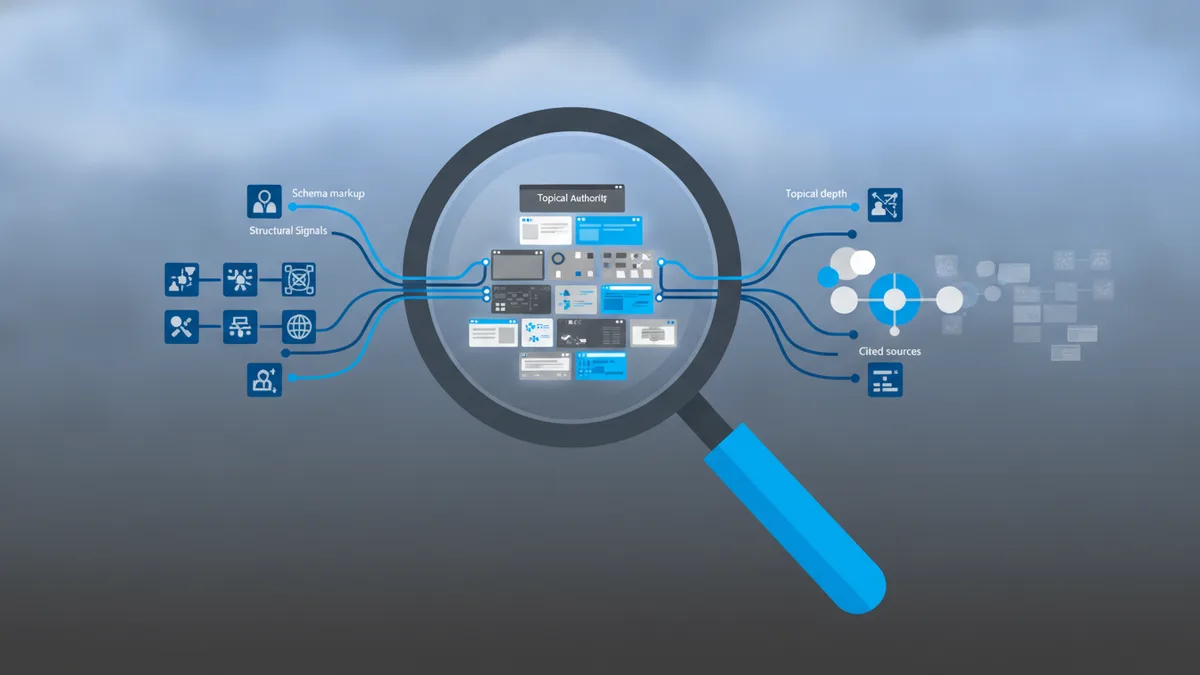
The visibility gap exists because AI engines rely on two primary signals that traditional SEO overlooks: schema markup that explicitly defines your content's structure and topical depth that demonstrates authority across related subtopics. A single well-optimized page ranks in traditional search. A cluster of interconnected, thematically related content ranks in AI Search. This distinction shapes everything that follows.
Understanding How Generative Engines Identify and Cite Sources
Generative engines use large language models trained on vast text corpora to answer user queries. When a user asks a question, the engine retrieves relevant passages from its training data and from the live web, then synthesizes them into a response. The engine cites sources—linking back to the original pages—when it uses specific information or direct quotes. Understanding this process reveals why visibility in AI Search depends on making your content machine-readable and topically comprehensive.
Schema markup—structured data in JSON-LD format—tells generative engines what your content is about before they read it. A page about "customer retention strategies" with no schema markup is just text to an LLM. The same page with properly implemented schema markup that identifies it as an Article, defines its author, publication date, and topic categories, becomes immediately recognizable as a credible source on that subject. Generative engines weight schema-marked content more heavily when synthesizing answers because the markup reduces ambiguity about the content's purpose and scope.
Topical authority—the depth and breadth of content you publish on a related set of topics—signals to generative engines that your domain is a reliable source on that subject. If you publish one article on "customer retention," you may be cited occasionally. If you publish ten interconnected articles covering retention metrics, churn analysis, loyalty programs, and retention technology, you become a topical authority that generative engines cite repeatedly. This clustering effect is why AI-optimized content strategies differ fundamentally from traditional SEO approaches.
The Role of Schema Markup in AI Search Visibility
Schema markup is the technical foundation of AI Search visibility. It provides explicit, machine-readable context about your content's structure, type, and subject matter. Without it, generative engines must infer meaning from natural language alone—a process prone to misinterpretation. With it, your content's purpose and authority are immediately clear.
Which Schema Types Matter Most
Article schema is the baseline. It identifies a page as a published article, includes metadata like headline, author, publication date, and article body. This schema type is essential for blog posts, guides, and thought leadership content. Generative engines use Article schema to determine whether a source is timely, credible, and relevant to a user's query.
Organization schema identifies your business entity, including name, logo, contact information, and social profiles. This schema builds foundational credibility and helps generative engines understand your domain's scope and authority. It's particularly important for SaaS and B2B companies that need to establish domain-level authority.
BreadcrumbList schema maps the hierarchical structure of your content. If you organize articles into topic clusters—for example, "Customer Retention" > "Retention Metrics" > "Customer Lifetime Value"—breadcrumb schema tells generative engines how these pages relate to each other. This relationship mapping strengthens topical authority signals.
Implementation Fundamentals
Schema markup must be valid JSON-LD format embedded in your page's
or section. Common errors—missing required fields, incorrect data types, or orphaned markup—render schema ineffective. Generative engines skip invalid schema, so validation is non-negotiable. Tools like Google's Rich Results Test and Schema.org's documentation provide validation guidance.Schema markup must also be kept current. If an article's publication date is outdated or author information is incorrect, the markup undermines rather than supports credibility. Maintenance of schema across your content library is an ongoing operational requirement, not a one-time implementation.
Building Topical Authority for AI Search Recognition
Topical authority is the second pillar of AI Search visibility. It refers to the depth and interconnectedness of content you publish on a specific subject area. Generative engines recognize topical authority by analyzing the volume, quality, and semantic relationships between articles on your domain.
A practical example: A SaaS Company selling project management software publishes one article on "how to improve team collaboration." It may be cited in AI Search results occasionally. But if the company publishes a cluster of ten to fifteen articles covering collaboration best practices, remote team management, asynchronous communication, meeting facilitation, and collaboration tools—each internally linked and topically related—generative engines recognize the domain as an authority on collaboration. Citations increase significantly because the engine has high confidence that this domain will have relevant, credible information on related queries.
Building topical authority requires a content strategy that prioritizes breadth and interconnection over individual article performance. Instead of publishing one article per month on random topics, publish multiple articles per month on a cohesive subject area. Link articles together thematically. Use consistent terminology and cross-reference related concepts. This approach takes longer to show results than traditional SEO but produces compounding visibility gains in generative search.
Measuring Your Current Visibility in Generative Search
Before optimizing, establish a baseline. Most marketing teams have no visibility into whether their content is cited in AI Search results. This measurement gap means they cannot prioritize optimization efforts or track progress.
Manual testing is the first step. Search for high-intent queries related to your business in ChatGPT and Google's search interface to see if your domain appears in AI-generated responses. Document which queries cite you and which do not. This qualitative data reveals patterns: perhaps your domain is cited for product-related queries but not for educational content, or vice versa. These patterns guide your optimization roadmap.
Programmatic measurement requires tools designed specifically for AI Search visibility. A comprehensive AI visibility checker can track citations across ChatGPT and Google AI Overview over time, showing you which content is cited, how often, and in response to which queries. This data transforms AI Search visibility from an intuition-based guess into a measurable KPI.
Document your baseline across at least 50–100 high-intent queries relevant to your business. This establishes a reference point against which you can measure the impact of optimization efforts over the following months.
A Practical Optimization Roadmap
AI Search optimization is not a replacement for traditional SEO, paid search, or content marketing—it is a complementary discipline that works alongside these channels. However, it requires distinct tactics and a different content cadence.
Phase One: Technical Foundation (Weeks 1–4)
Audit your existing content for schema markup. Identify which pages have valid Article, Organization, and BreadcrumbList schema and which do not. Prioritize high-traffic pages and pages that target high-intent queries. Implement missing schema markup, starting with your top 20–30 pages. Validate all markup before deployment.
Phase Two: Topical Clustering (Weeks 5–12)
Identify 3–5 core topic areas aligned with your business. For each topic, map out 8–15 related subtopics that you will cover in depth. Create an editorial calendar that publishes 2–3 articles per week on these topics, ensuring each article links to related articles within the cluster. This phase establishes topical authority signals that generative engines recognize.
Phase Three: Measurement and Iteration (Ongoing)
Monitor AI Search visibility using your baseline measurement approach. Identify which new content is cited and which is not. Analyze the queries that cite your domain and optimize for related queries you are not yet ranking for. Adjust your topical clusters based on data. This iterative approach compounds visibility gains over time.
A more detailed strategic framework for this work is available in AI Search visibility strategy resources, which covers quarterly planning, competitive analysis, and integration with traditional SEO efforts.
Common Mistakes That Reduce AI Search Visibility
Marketing teams new to AI Search optimization often make predictable errors that undermine their efforts. Awareness of these mistakes accelerates your path to visibility.
Treating AI Search optimization as a one-time project is the first major mistake. Teams implement schema markup, publish a few topical articles, then move on. Generative engines reward sustained, consistent investment in topical authority. Visibility builds over months, not weeks. Teams that treat AI Search optimization as an ongoing discipline—with dedicated content production, regular schema maintenance, and quarterly measurement reviews—see compounding results. Teams that treat it as a project see initial gains that plateau.
Publishing content without schema markup is the second mistake. Many teams publish high-quality articles but fail to implement the schema markup that makes those articles machine-readable to generative engines. The content exists but remains invisible. Schema implementation must be a non-negotiable part of your publishing workflow, not an afterthought.
Ignoring topical interconnection is the third mistake. Teams publish articles on random topics, each optimized for traditional SEO, without considering whether those articles build topical authority. This approach maximizes traditional search visibility but minimizes AI Search visibility. Intentional topical clustering—choosing 3–5 core areas and publishing deeply within them—is essential.
Next Steps
Start with measurement. Establish a baseline of your current visibility in ChatGPT and Google AI Overview across your highest-intent queries. Document which content is cited and which is not. This baseline transforms optimization from guesswork into a data-driven process.
Next, audit your technical foundation. Implement schema markup on your top 20–30 pages, prioritizing high-traffic and high-intent content. Validation is essential—invalid schema provides no benefit.
Finally, commit to a topical content strategy. Choose 3–5 core topics aligned with your business and plan to publish 8–15 articles per topic over the next 6–12 months. This sustained investment builds the topical authority that generative engines recognize and cite.
If you want to accelerate this process, platforms designed for AI Search visibility can automate schema implementation and topical content production, reducing the operational burden on your team. The core principles—schema markup, topical authority, and sustained investment—remain constant regardless of the tools you use.
Ready to Get Found by AI Search Engines?
Schema injection plus up to 10 autopilot SEO articles a month. One script tag. Set it once and let it run.